If you run a local business in Spain, your Google reviews are probably your most valuable trust signal. Someone searching "reformas cerca de mí" or "gestoría en Badalona" sees your star rating before they see anything else. That is exactly why Google has spent 2026 tightening the rules on how you can ask for reviews, and why several tactics that agencies sold as best practice a few years ago are now policy violations that can get your reviews wiped or your profile suspended.
This is not marketing folklore. It comes straight from Google's official Prohibited & Restricted Content policy for Maps, updated in early 2026. Here is what changed, what is still allowed, and how to collect reviews without putting your profile at risk.
What Google banned or clarified in 2026
The core principle has not changed: a review must reflect a genuine, unbiased experience. What changed in the April 2026 update is how specific Google now is about what counts as manipulation. Two new prohibitions were added on top of the long-standing ones.
New in 2026: no asking customers to name a staff member. You can no longer request that a review mention a specific employee ("menciona a Javier en tu reseña"). Google's policy now explicitly prohibits merchants from requesting that staff solicit reviews that include specific content, including content that identifies a staff member.
New in 2026: no review quotas for staff. Directing your team to hit a certain number of reviews in a given period is now an explicit violation. No more "necesitamos 10 reseñas este mes, que las pida cada uno".
Still banned (and enforced harder than ever):
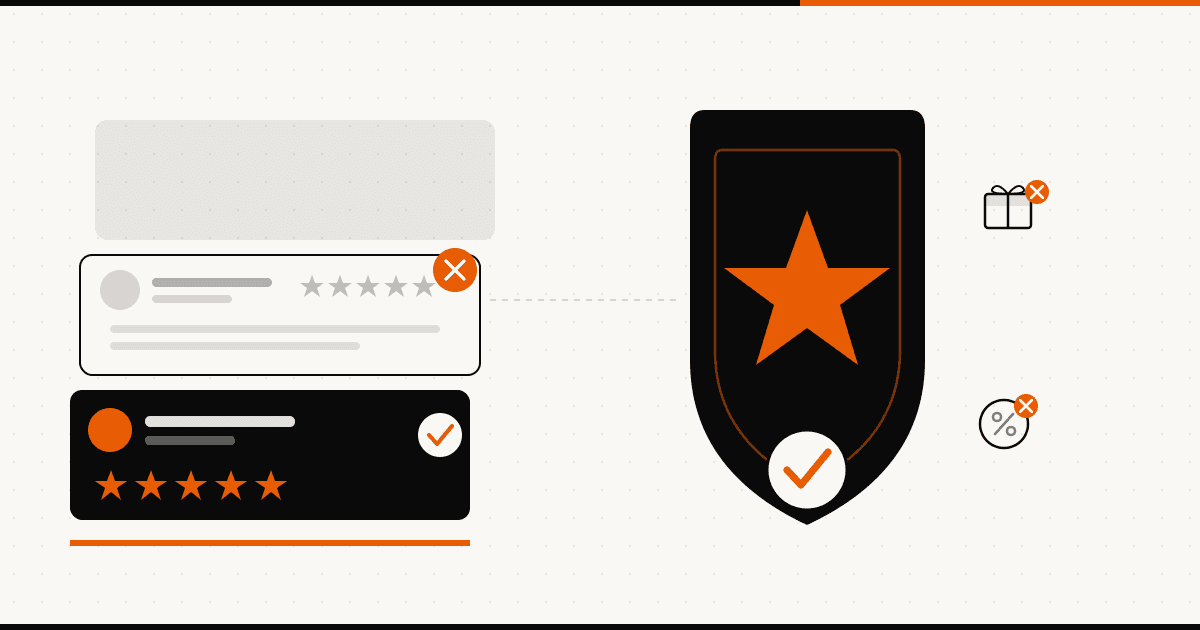
- Incentives of any kind. You cannot offer payment, discounts, free goods, or services in exchange for a review. This applies whether the review is positive or not, and whether you are asking for a new review or asking someone to revise or remove a negative one. A raffle entry, a 10% discount on the next visit, or a small gift all count.
- Review gating. This is selectively asking only happy customers for a public review while routing unhappy ones to a private form. The classic version is a survey that sends 4-and-5-star responses to Google and everything below to an internal channel. You must ask everyone the same way, regardless of how you expect them to respond.
- On-premises pressure. Requiring or pressuring customers to leave a review while they are still on your premises is prohibited. This is what makes review kiosks, shared tablets, and in-store review stations a policy problem.
- Conflict-of-interest reviews. Reviews from current or former employees, vendors, family members, or competitors are not allowed.
Why this matters more in 2026
Google is not just writing rules, it is enforcing them with automated systems. The volume of fake reviews has risen sharply, driven in part by AI making them cheap to produce, so Google keeps tightening both the policy and the detection behind it. Businesses have reported waves of reviews disappearing, sometimes legitimate 5-star ones caught in the sweep.
The consequence scale is real: content removal first, then listing penalties, then in serious or repeated cases, profile suspension. Losing your Google Business Profile is not a minor inconvenience for a local business. It is disappearing from the map at the exact moment a customer is looking for you. If you run a renovation company, this ties directly into how to get renovation clients from Google, where reviews are one of the key ranking factors.
Need a professional website?
Starter Package from €790. Design + SEO + 2-week delivery.
See Starter PackageWhat you CAN still do (a compliant 2026 checklist)
Google still wants you to collect reviews. The platform explicitly allows merchants to encourage genuine reviews as long as there is no incentive and no pressure. Here is what a clean strategy looks like:
- Ask everyone, the same way. Send a follow-up email or SMS to every customer after the job is done, not just the ones you expect to be happy.
- Make it easy. Share a direct review link or a QR code on your receipts, in your email signature, or on a card you hand over after the work.
- Ask in person, openly. You can verbally ask a customer if they would be willing to share their experience, as long as you do not tell them what to write or pressure them to do it on the spot.
- Respond to every review, good and bad. Replying to reviews is allowed, encouraged, and one of the strongest local ranking signals. A calm, professional reply to a negative review reads better to future customers than the complaint itself.
- Keep the profile fresh. Update your hours, add photos of recent work, and post news. Profiles that sit untouched for weeks lose visibility.
The one-line summary: ask openly, ask everyone, attach nothing.
A note for regulated sectors
If you work in a sector like healthcare, legal, or finance (clínicas, abogados, asesores), be extra careful. These are the categories Google watches most closely, and the same review that would be harmless for a restaurant can be scrutinised harder here. Stick rigidly to the "ask everyone, no incentive, no content direction" rule, and never respond to a review in a way that reveals a client's personal or confidential information, which would create a separate RGPD problem on top of the Google one. If you run an accounting or legal firm, this same logic of protecting client data is what I cover in the guide to client portals and the GDPR.
The honest takeaway
Most of the review tactics that got quietly recommended over the last few years (the satisfaction survey that filters who gets the Google link, the discount for a 5-star, the "mention our technician by name") are now the exact things that get your reviews removed. The safe strategy in 2026 is also the simplest one: do good work, ask every customer openly to share their honest experience, make it frictionless, and respond to what comes in. That is not just the compliant path, it is the one that builds a review profile that actually survives Google's next enforcement wave.
If your Google Business Profile needs setting up properly, or your website is not converting the traffic those reviews send you, that is exactly the kind of work I do.
Need something more advanced?
Professional Package from €1,490. E-commerce, CMS, advanced SEO.
See Professional PackageSources
- Google, Prohibited & Restricted Content, Maps User Generated Content Policy (support.google.com/contributionpolicy/answer/7400114), checked July 2026 [T1]
- Google, Incentivized or Biased Reviews policy (support.google.com/contributionpolicy), checked July 2026 [T1]
- Industry analysis of the April 2026 policy update (multiple SEO practitioner sources), checked July 2026 [T2]