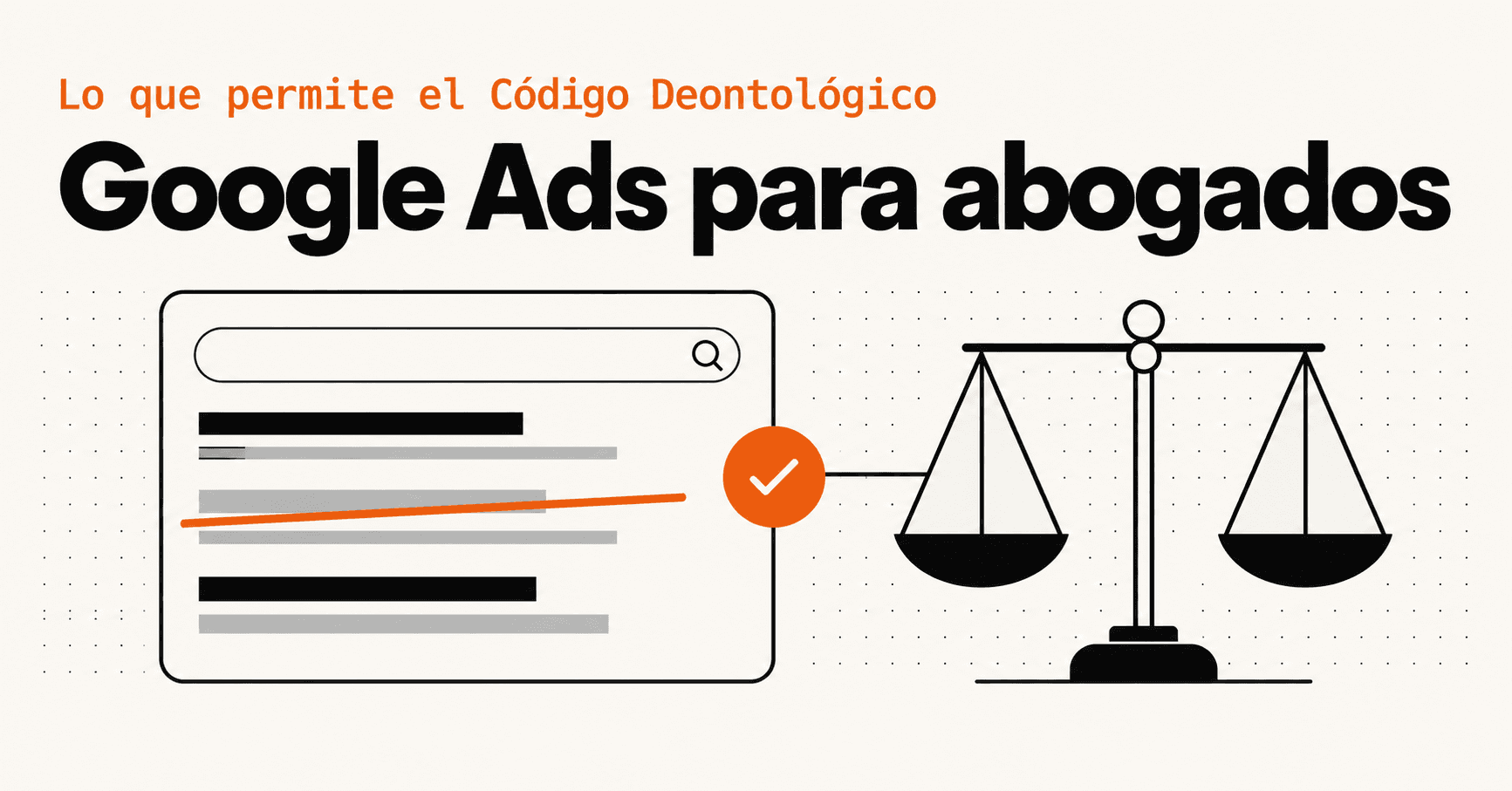
Running Google Ads as a lawyer in Spain is allowed. What many firms do not realise is that every text ad they publish is advertising under article 6 of the Código Deontológico de la Abogacía Española, approved by the Consejo General in March 2019 and in force since 8 May 2019. And a search ad is the most compressed advertising you will ever write: headlines of a few words, where exaggeration creeps in almost by itself.
I build websites for law firms, so I read the Código itself rather than the summaries. This is what it means for your ads specifically, headline by headline.
Yes, you can advertise. On three conditions
The starting point is permissive. Article 6.1 lets you advertise your professional services freely, provided you respect the law on advertising, competition and unfair competition, and the profession's own ethical rules.
Article 6.2 adds how: your advertising must respect independence, dignity, integrity and professional secrecy, and it must be objective, truthful and dignified, both in what it says and in the channel you use.
And article 6.3 contains a requirement that almost nobody applies to their ads: your advertising must state the Colegio you belong to. In a search ad, space is tight, so the practical question is where. My conservative reading: include it wherever the format allows, and never omit it from the page the ad sends people to.
The headlines that get you into trouble
These are the patterns I see most often in law firm ads, with the rule each one runs into.
"Win your case" or "get your money back, guaranteed." Article 6.3.d prohibits promising results that do not depend exclusively on you. A court ruling never depends exclusively on you, so this one is close to absolute.
"Divorce specialist." Article 6.4 requires any claim of specialisation to be backed by academic or professional qualifications, officially recognised specialist training, or prolonged professional practice. The word is allowed. It just has to be true and supportable.
"Free first consultation." Article 7.3.d treats as disloyal the offer of services that appear free when they are not and can confuse consumers. If the first consultation is genuinely free, you can say so. If it quietly becomes the first billable hour, you cannot.
"Over 500 satisfied clients" or naming who you work for. Article 6.3.e prohibits referring to clients without their written authorisation. Aggregate claims need care, and named clients need the paperwork.
"Been dismissed? Sue now." Article 6.3.b prohibits inciting litigation or conflict, generically or specifically. The same need can be addressed informatively: explain what the person's options are, rather than pushing them towards a lawsuit.
Need something more advanced?
Professional Package from €1,490. E-commerce, CMS, advanced SEO.
See Professional PackageAccident keywords: the most delicate area
Article 6.3.c is the rule that matters most for anyone bidding on accident or injury searches.
It prohibits offering professional services, directly or through third parties, to victims of recent accidents or misfortunes who lack full and calm freedom of choice, and to their heirs. For catastrophes or public calamities affecting large numbers of people, it adds a hard floor: never before 45 days have passed since the event. The prohibitions lift when the victim has expressly requested the service.
Here is the honest part: the text does not settle whether someone actively searching Google counts as expressly requesting the service. I have not found an authoritative answer to that, and I would not trust an agency that tells you it is obviously fine. What I can tell you is that the Consejo General's ethics commission has publicly insisted on this rule, for example reminding firms of it during the pandemic. The prudent approach: keep accident ads informative rather than predatory, and never build campaigns triggered by a specific tragedy.
If an agency runs your ads, you are still responsible
This one surprises most lawyers. Article 7.3.c treats the use of third parties to get around ethical obligations as disloyal, and it adds that the party benefiting from advertising done by a third party is considered responsible, unless proven otherwise.
In practice: if your agency writes an ad that promises results, the complaint lands on you, not on them. Read and approve every ad before it goes live. "My agency wrote it" is exactly the defence the rule anticipates.
Pay-per-lead platforms
A related point worth checking. Article 18 prohibits paying commissions or any other compensation to third parties for sending you a client, unless the client is informed of it.
I am not saying every lead platform breaches this. Arrangements differ, and some are structured as advertising rather than referral fees. But if you pay per client delivered, it is worth asking how your arrangement fits article 18 before you scale it.
The page the click lands on is advertising too
Everything above applies to your landing page as well, and article 21 adds a specific duty for websites: in webs and electronic services you must identify yourself with your name, your firm's name where applicable, your Colegio and your colegiado number.
So the page a paid visitor lands on needs the same care as the ad: no promised results, justified specialisation claims, your Colegio and number visible, and an informative tone rather than a pushy one. The structure that captures qualified cases, one page per practice area written around the client's problem, is the one I describe in website and SEO for lawyers.
Check your own Colegio
The Código describes itself as basic rules that the regional Consejos and the Colegios can develop and adapt for their own territory. So the national text is the floor, not necessarily the ceiling. If you practise in Barcelona, it is worth checking what the ICAB adds before launching a campaign.
The honest takeaway
Paid ads and the Código are compatible. The firms that get into trouble are almost always the ones whose ads were written like any other local business: guarantees, urgency, testimonials, pressure. Write your ads the way the Código asks you to practise, objective and truthful, and they will also filter for better clients.
If you want the page behind those ads built to the same standard, that is exactly what I do. The general investment ranges are in how much a website costs in Spain.
Need something more advanced?
Professional Package from €1,490. E-commerce, CMS, advanced SEO.
See Professional PackageSources
- Consejo General de la Abogacía Española, Código Deontológico de la Abogacía Española, approved 6 March 2019, in force 8 May 2019, articles 1, 6, 7, 18 and 21, text as published by the Il·lustre Col·legi de l'Advocacia de Barcelona, checked September 2026 [T1]
- Consejo General de la Abogacía Española, Comisión de Deontología statement recalling articles 6.3.b and 6.3.c during the pandemic (abogacia.es), checked September 2026 [T1]