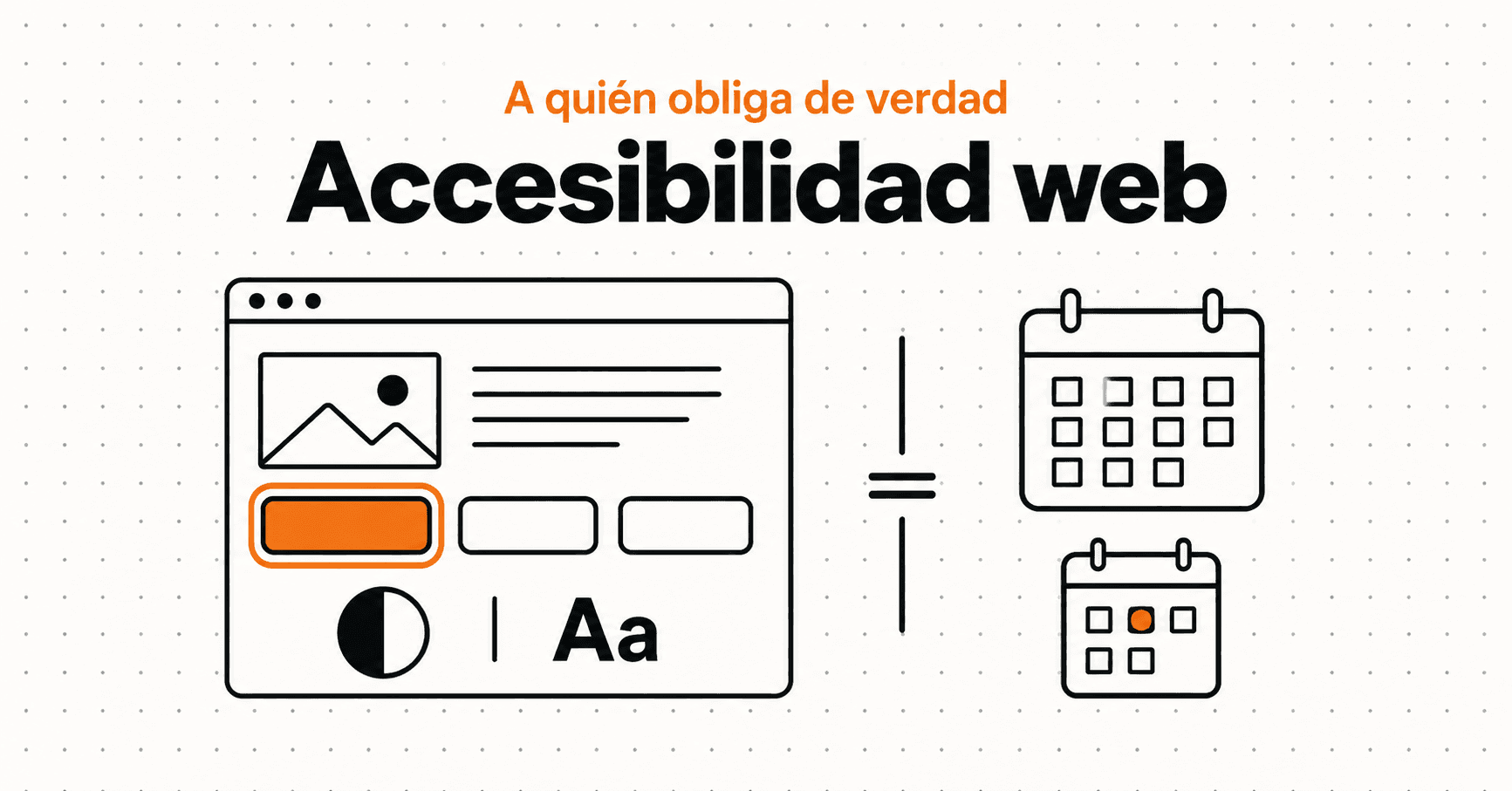
If you run a small business in Spain, you have probably received an email this year telling you your website breaches the accessibility law and you need an urgent audit. Before you pay for anything, it is worth separating what the rules actually say, because for most small businesses the honest answer is the opposite of what those emails claim.
I have read the source texts rather than the summaries. Here is who is genuinely obliged, from when, and the exemption almost nobody in this conversation mentions.
Two different rules, two different calendars
Most of the confusion comes from mixing up two separate pieces of legislation.
Ley 11/2023 transposes the EU's Directive 2019/882, the European Accessibility Act. Its own preamble states the directive set a longer period for effective application, specifically until 28 June 2025. That date is real, and it is the one the alarming emails lean on. But it applies to a defined list of products and services, not to every website in Spain.
RD 193/2023 is the separate Spanish regulation on basic accessibility conditions for goods and services available to the public. Its calendar for the general private sector is much later: 1 January 2029 for new goods and services, and 1 January 2030 for existing ones that need reasonable adjustments.
So when someone tells you "the accessibility law came into force in June 2025, your site is illegal", they are quoting the first rule and applying it to businesses that fall under the second, or under neither.
Which services actually entered scope in June 2025
Ley 11/2023 covers a specific list. The ones that matter for a small business in Spain are ecommerce, consumer banking services, electronic communications services, passenger transport services and e-books.
The distinction that matters: a corporate website that describes what you do and offers a contact form is not the same thing as ecommerce. If your site sells online, you are looking at a covered service. If it informs, you are very probably not in the June 2025 group at all.
Need something more advanced?
Professional Package from €1,490. E-commerce, CMS, advanced SEO.
See Professional PackageThe exemption almost nobody mentions
Here is the part that changes the answer for most readers of this blog, and that I have not seen in a single one of those warning emails.
Article 3 of Ley 11/2023 exempts microenterprises that provide services from complying with the accessibility requirements and from any obligation relating to that compliance. The wording comes straight from the directive it transposes, whose article 4.5 says the same thing.
A microenterprise here means the standard EU definition: fewer than 10 employees and an annual turnover or annual balance sheet total not exceeding 2 million euros.
Read that against your own business. A self-employed professional, a four-person gestoría, a dental clinic with six staff, a small agency: all providing services, all under both thresholds. Under Ley 11/2023, they are exempt. Even if they sell online, because ecommerce is a service.
That is not a loophole or a grey area. It is an express exemption in the article itself.
Three qualifications that matter
Before you conclude you can ignore this entirely, three things narrow it.
The exemption covers services, not products. If your business manufactures, imports or distributes a product covered by the law, the product obligations still reach you. The service exemption does not carry over.
The threshold moves. It is measured on your current situation. Cross 10 employees or 2 million euros and the exemption disappears and the obligation is full. If you are near either line, building accessibly now is far cheaper than retrofitting later.
If you are not a microenterprise and you sell online, you are already in scope. Not in 2029. Since June 2025. For a company of 15 people running an online store, this is not a future problem.
And separately from all of it, RD 193/2023 still sets 2029 and 2030 for the wider private sector, so "exempt today" is not "exempt forever".
Why I would do it anyway
I am telling you that you are probably exempt. I am also going to tell you to do a good part of it regardless, and the reason is not moral pressure.
The preamble of Ley 11/2023 itself cites the INE's EDAD 2020 survey: 4.3 million people in Spain have some form of disability, a figure expected to rise as the population ages. That is your market too, and a site that a person with low vision or limited mobility cannot use is a site that loses those customers silently.
There is also a practical overlap. Much of what the technical standard asks for is what a well-built site does anyway: real alt text on images, sufficient colour contrast, headings in a logical order, forms with proper labels, full keyboard navigation, captions on video. Several of those are also things search engines read. The reference standard is UNE-EN 301549, which in practice means the WCAG 2.1 guidelines at level AA.
None of that requires an expensive plugin overlay. Most of it is decisions made while the site is being built.
What to actually do now
- Work out which group you are in. Under 10 people and under 2 million euros, providing services: exempt under Ley 11/2023. Over either threshold with an online store: in scope since June 2025. Neither: your horizon is RD 193/2023 in 2029 and 2030.
- Do not buy an urgent audit on the strength of a cold email. Ask which rule they say applies to you and which article. If they cannot answer, that tells you enough.
- Get the basics right regardless. Alt text, contrast, heading structure, labelled forms, keyboard navigation. Cheap during development, expensive afterwards.
- Be wary of accessibility overlay widgets. A script that claims to make any site compliant in one line of code does not, and it will not satisfy a real assessment.
If you are building or rebuilding a site, the sensible move is to get these things right from the start rather than bolt them on. That is the same argument I make about WordPress versus custom development, and if you want the investment ranges, they are in how much a website costs in Spain. If you run an online store, note that ecommerce is the one case here where the obligation may already apply to you: what an online store really costs covers the rest of that picture.
Need something more advanced?
Professional Package from €1,490. E-commerce, CMS, advanced SEO.
See Professional PackageSources
- BOE, Ley 11/2023, de 8 de mayo (BOE-A-2023-11022), transposing Directive (UE) 2019/882: preamble on effective application from 28 June 2025 and on the INE EDAD 2020 figure of 4.3 million people with disabilities; article 3 on the exemption for microenterprises providing services, checked September 2026 [T1]
- Congreso de los Diputados, official text of the bill for Ley 11/2023 (BOCG-14-A-126), wording of the microenterprise exemption, checked September 2026 [T1]
- BOE, Directive (UE) 2019/882 (DOUE-L-2019-80999), article 4.5, equivalent exemption for microenterprises providing services, checked September 2026 [T1]
- BOE, Real Decreto 193/2023, de 21 de marzo, calendar of application for the private sector (1 January 2029 and 1 January 2030), checked September 2026 [T1]