If you run an estate agency in Spain, most of your leads probably arrive through Idealista or Fotocasa. It works, but it is worth looking straight at what that means: your lead flow is rented. You pay per contact, you appear alongside your competitors on the same listing, and the day you stop paying your visibility disappears without a trace.
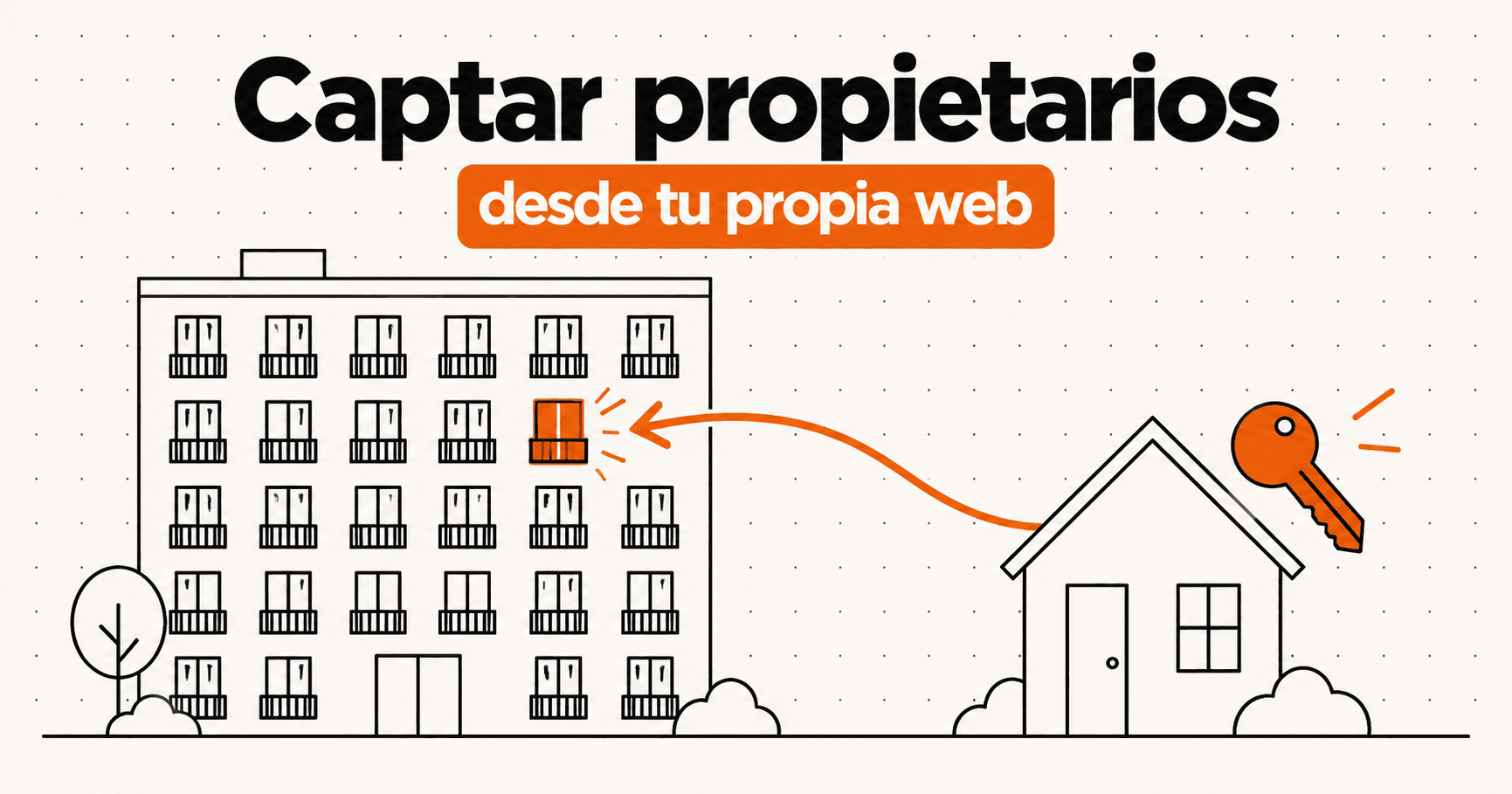
This article is about the other half of the business, the half almost nobody works on: capturing property owners through a channel that is actually yours. And it comes with an honest warning attached, because the easy "escape the portals" pitch falls apart as soon as you look at the detail.
The real size of the imbalance
The numbers show why this matters. According to Spain's INE, there are 215,591 real estate businesses in the country, and in 2025 there were 714,237 home sales, up 11.5% on the previous year. The market is moving.
The problem is where the attention sits. According to GfK DAM measurement (September 2025), property portals draw 14.7 million monthly users in Spain, of which 10.8 million pass through Idealista. That audience is enormous, but it is not yours: it works for the portal, which resells it to you one contact at a time.
Buyers and owners are not the same problem
Here is the asymmetry almost nobody names. The portals are optimised for the buyer: someone looking for a flat finds thousands of listings, and you compete to appear among them.
But an agency's scarce resource is not buyers. It is stock: the properties on your books. And those come from the owner who decides to sell.
That owner behaves very differently. Before calling any agency, they almost always type the same question into Google: what is my home worth. If you are not there at that moment, the portal is, the contact is generated on their platform rather than yours, and then they sell it back to you.
Working on owner acquisition means, in practice, stepping out of the saturated side of the market and building on the scarce side.
Need something more advanced?
Professional Package from €1,490. E-commerce, CMS, advanced SEO.
See Professional PackageThe uncomfortable part: the portals sell you that tool too
This is where agency pitches usually cheat, so let me be direct: the portals are not out of this game. Fotocasa Pro sells a valuation widget you install on your own website with a single line of code, so your visitors can value their home and you receive their details. On top of that there is an entire market of vendors selling exactly the same thing on subscription.
In other words, you could put a valuation tool on your site tomorrow without building anything. That is true and worth knowing.
What changes is not whether you have the tool, but who owns it. And that brings back the usual question: if you stop paying the fee, what is left?
Four questions before you sign for a valuation tool
Before committing to any provider (portal, SaaS or agency), these four questions separate an asset from a rental:
Who owns the lead? A form sitting on your domain does not guarantee the contact is yours alone. Ask in writing whether that data is shared, aggregated or resold.
Who owns the tool? A third-party widget is a subscription: stop paying and the valuation page on your site goes blank. A custom-built module is your code, and it keeps working whether or not a monthly fee is running.
Where does the data live? An owner's details (name, phone, property address) are personal data under the RGPD. If a provider processes them on your behalf, they are a data processor and you need the corresponding contract. This is not optional, and hardly anyone asks.
What happens if you switch? If you change provider or CRM tomorrow, do you take the owner database you have built with you, or does it stay inside the platform?
What the website needs for this to work
An agency website that captures owners, rather than just displaying flats, tends to share the same structure:
- A dedicated page for the owner. Not a link buried in the footer: a page visible from the menu, written for someone thinking about selling, not for someone looking to buy.
- A valuation as the entry point. It is the most natural value exchange in the sector: the owner gets an estimate, you get the contact and the context of the property.
- Local SEO by area and neighbourhood. Owner searches are local by definition. One page per area, with real content about that market, is what competes; not a template with the district name swapped in, which Google treats as duplicate content.
- Visible social proof. Real reviews and closed deals. If you are going to work on reviews, do it within the rules: Google's 2026 policy prohibits incentivising them and filtering who gets to leave them.
- CRM integration without lock-in. Via feed or API, so you avoid duplicate work, but without the CRM becoming the owner of your website.
An honest note on expectations and on numbers
Two things I would rather say before someone else sells them to you.
First: this is not immediate. Local search visibility matures over months, not weeks. If you need owners this quarter, the sensible move is to pair the website with paid campaigns while the organic channel grows. Nobody serious can promise you a Google position within a specific timeframe.
Second: if you research this topic you will find very specific and very attractive figures about how many extra leads a valuation tool delivers, or what percentage of sales begin with an online valuation. You will not see them here, because I could not trace them to any primary source: they circulate between vendor websites that cite each other. The case for working on owner acquisition does not need those numbers. The market asymmetry carries it on its own.
Where to start
If you already have a website, the first step is not rebuilding it: it is checking whether a page exists that speaks to the owner, and whether the contact it generates lands in your database or someone else's. If that page does not exist, that is the gap.
At SolidaWeb I build custom websites for estate agencies with owner acquisition built in rather than bolted on with a third-party widget: the valuation module, the area pages and the CRM connection, with the code owned by you. There is more detail on the web design for real estate agencies page, and if you want to know the investment range this sits in, I break it down in how much a website costs in Spain.
Need something more advanced?
Professional Package from €1,490. E-commerce, CMS, advanced SEO.
See Professional PackageSources
- INE, Statistics on Transfers of Property Rights (ETDP): 714,237 home sales in Spain in 2025, up 11.5% year on year, checked August 2026 [T1]
- INE, DIRCE: 215,591 real estate businesses in Spain, checked August 2026 [T1]
- GfK DAM, digital audience measurement in Spain (September 2025): 14.7 million monthly unique users on property portals, 10.8 million on Idealista, checked August 2026 [T1]
- Fotocasa Pro, description of its valuation widget for embedding on a professional's own website (blogprofesional.fotocasa.es), checked August 2026 [T1 for its own product]
- Google, Prohibited & Restricted Content, reviews policy (support.google.com/contributionpolicy/answer/7400114), checked August 2026 [T1]