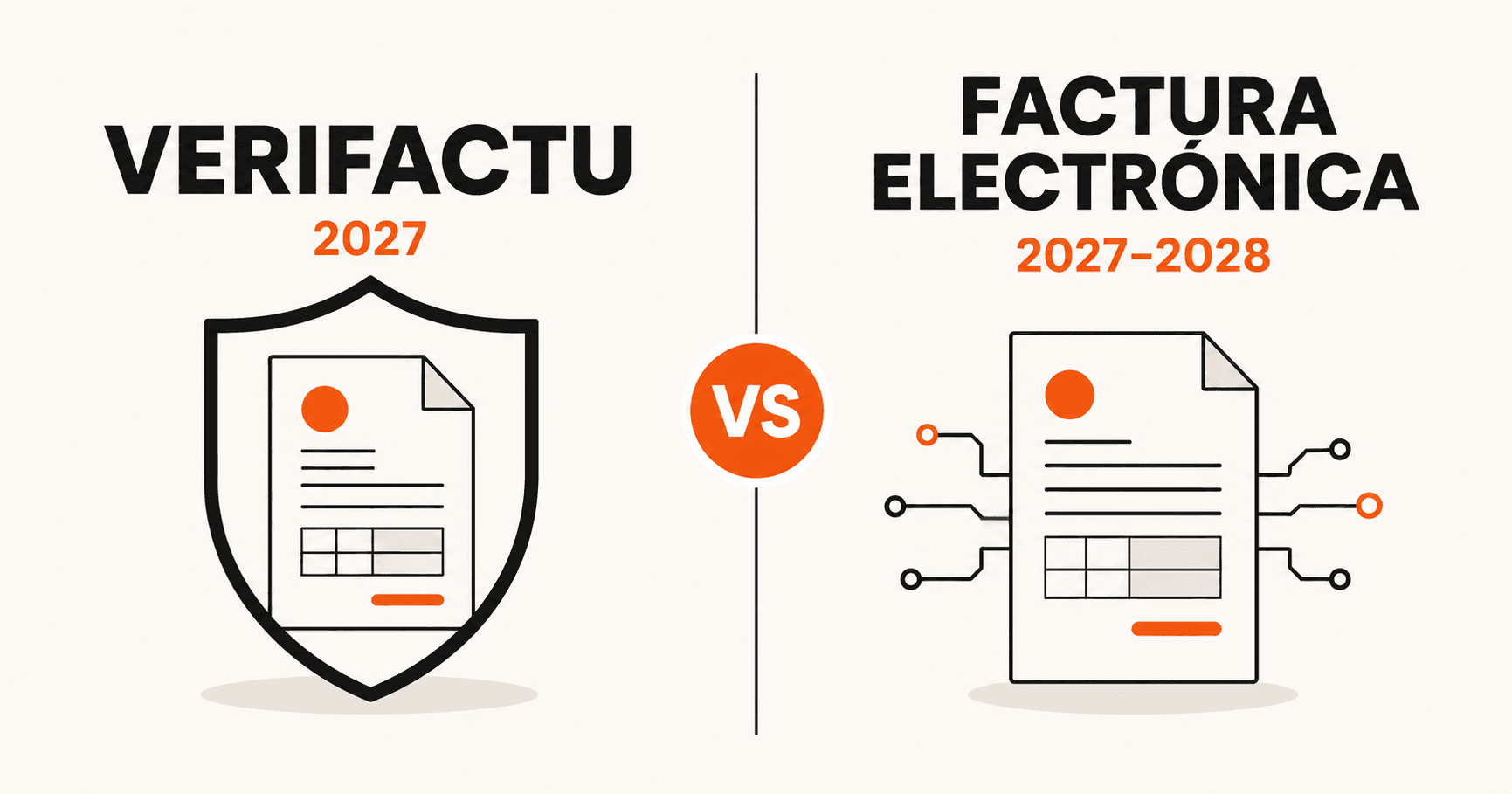
If you run a business or work as a freelancer in Spain, two different regulations that almost everyone mixes up will affect you over the next two years: Verifactu and the mandatory B2B electronic invoice. They are not the same thing, they do not come from the same law, they do not start on the same dates and they do not demand the same changes. And most importantly: you will very likely have to comply with both.
Here is the clear comparison, with the official dates from the Spanish Tax Agency and none of the software-vendor alarmism.
The confusion, explained in two sentences
Verifactu regulates the software you issue invoices with: it requires your invoicing records to be complete, traceable and tamper-proof, so the tax authority can verify nothing is manipulated. The mandatory electronic invoice regulates the document and how it travels: it forces invoices between companies and freelancers to be electronic and structured, to digitalise the economy and fight late payments.
One watches the software. The other changes the format. That is why neither replaces the other.
Comparison table: how they differ
| Verifactu | B2B electronic invoice | |
|---|---|---|
| Source law | Law 11/2021 (Anti-fraud) | Law 18/2022 (Crea y Crece) |
| Goal | Fight tax fraud | Digitalise and fight late payments |
| What it regulates | Invoicing software and its records | The document format and delivery channel |
| Invoices affected | All of them: to companies, consumers and public bodies | Only between companies and freelancers (B2B) in Spain |
| Can you still hand over a paper invoice? | Yes: it regulates the internal record, not the medium | Not for B2B operations, once in force |
| Implementing rules | Royal Decree 1007/2023, deadlines via RD-law 15/2025 | Royal Decree 238/2026 |
The full calendar, date by date
These are the four dates that matter, according to the Spanish Tax Agency:
| Date | What starts | Who it affects |
|---|---|---|
| 1 January 2027 | Verifactu | Companies filing corporate income tax |
| 1 July 2027 | Verifactu | Freelancers and all other taxpayers |
| 1 October 2027 | B2B electronic invoice | Companies with turnover above 8 million euros |
| 1 October 2028 | B2B electronic invoice | Everyone else, companies and freelancers |
Notice the mental trap: Verifactu arrives first. Many businesses are planning for "the electronic invoice in 2028" and will crash into the Verifactu deadline of 2027 without seeing it coming.
Do I have to comply with both?
Almost certainly yes, if you invoice other businesses:
- You only sell to consumers (a hair salon, a physical shop): Verifactu affects you, because it regulates your invoicing software no matter who you sell to. The B2B electronic invoice does not apply to you.
- You invoice other companies or freelancers: both affect you. Your software will need to comply with Verifactu in 2027 and, on top of that, issue and receive structured electronic invoices in 2027 or 2028 depending on your turnover.
- You work with public administrations: B2G electronic invoicing has been mandatory for years through FACe; Verifactu applies to you as well.
Need something more advanced?
Professional Package from €1,490. E-commerce, CMS, advanced SEO.
See Professional PackageWhat to do now (without panic)
- Ask your invoicing software provider whether it will be Verifactu-ready before your date (January or July 2027). The main products on the market are already announcing it; if yours will not answer, that is a signal.
- If you invoice with Excel or Word, this change hits you directly: those records do not comply with Verifactu. You have until 2027 to move to a system that does.
- Do not buy "Verifactu solutions" out of fear: the penalty is real (up to 50,000 € per tax year for using non-adapted software), but there is time to adapt properly and compare options.
- Use the change to your advantage: if you are going to touch your invoicing system anyway, it is the moment to automate what you still do by hand. The full detail on Verifactu requirements and penalties is in my Verifactu guide for SMEs.
The strategic reading
These two regulations will force hundreds of thousands of businesses that currently run on paper, Excel and WhatsApp to digitalise. If your business makes the move early and well, you do not just avoid penalties: you position yourself ahead of your competition at the exact moment digitalisation stops being optional. Companies already working with modern systems will experience this transition as paperwork; the rest, as a crisis.
Need something more advanced?
Professional Package from €1,490. E-commerce, CMS, advanced SEO.
See Professional PackageSources
- Spanish Tax Agency: information note on the extended deadline for adapting invoicing software systems, updated March 2026: the 1 January and 1 July 2027 dates under Royal Decree-law 15/2025.
- Spanish Tax Agency: mandatory electronic invoicing, on Royal Decree 238/2026 and the October 2027 and October 2028 phases.
- Law 11/2021 on measures to prevent and fight tax fraud, and Law 18/2022 on business creation and growth (BOE).
- Verifactu for SMEs: what to prepare before 2027, the full guide on this blog.