Verifactu for SMBs in Spain: what to prepare before 2027
Verifactu becomes mandatory on January 1, 2027 for companies and on July 1, 2027 for self-employed in Spain. Non-compliance can result in fines up to €50,000 per fiscal year. The good news: if you use a modern Spanish invoicing platform (Holded, Factura Directa, FacturaScripts, Anfix), it's probably already compliant or will be in time. The less good: if you invoice with Excel, Word, or a custom in-house ERP, you have until 2027 to change the system, not just the process.
This guide covers the essentials: what Verifactu is, who it affects, what technical requirements it imposes, what happens if you don't comply, and where to start now.
What is Verifactu in one sentence?
It's the Verifiable Invoice Issuance System (Sistema de Emisión de Facturas Verificables): a set of technical requirements that every invoicing software in Spain must meet so the Spanish Tax Agency (AEAT) can verify that invoices are complete, authentic, and traceable. It sits within the framework of Law 11/2021 (Anti-Fraud Law) and was developed in Royal Decree 1007/2023, modified by Royal Decree-Law 15/2025 published in Spain's Official State Gazette (BOE) on December 3, 2025.
In short: AEAT wants to ensure that once you issue an invoice, you can't modify or delete it later without leaving a trail.
Who is affected and when?
The current deadlines after the extension published in December 2025:
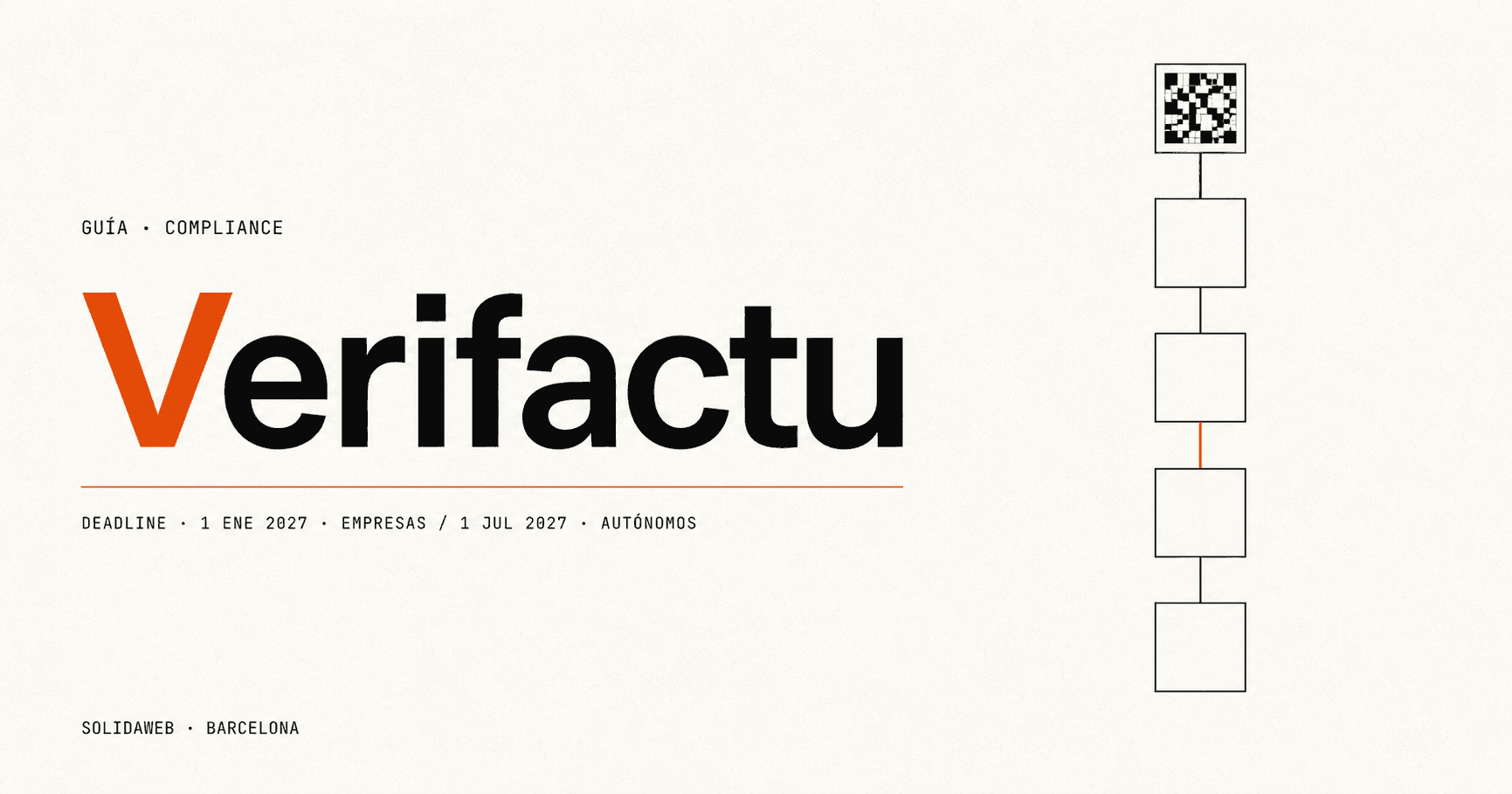
- Companies (subject to Corporate Income Tax): January 1, 2027
- Self-employed (IRPF with economic activity): July 1, 2027
- Entities under income-attribution regime with economic activity: July 1, 2027
- Non-residents with permanent establishment in Spain: depending on tax regime, generally July 1, 2027
The original deadlines were July 2025 for software manufacturers (already in force, with the main SaaS billing platforms already adapted) and January 2026 for users (postponed to the current schedule).
Who is exempt?
Not everyone has to adapt. The most common exemptions:
- Companies and self-employed registered in SII (Immediate Information Reporting). If you already submit your VAT books in real-time to AEAT (typically large companies, VAT groups, REDEME registrants), you are not required to use Verifactu.
- 100% manual invoicing without software, on paper. Applies to some self-employed with very low volume. In practice, almost no one.
- Companies and self-employed domiciled in the Basque Country or Navarra. They have their own regional tax regimes (TicketBAI in Euskadi and the equivalent system in Navarra). If you file taxes in those territories, Verifactu does not apply.
If your business does not fall into any of those three categories, you must adapt before your corresponding deadline.
What technical requirements does the system impose?
The regulation governing Invoicing Information Systems (RRSIF) defines four mandatory technical requirements:
1. Integrity
Each issued invoice must be recorded in an unalterable form. It cannot be edited or deleted without the system recording the change (through corrective invoices, registered annulments, full audit logs).
2. Authenticity
Every invoice must carry an electronic signature from the issuer or the system itself, with a valid certificate. This proves who issued it and when.
3. Traceability through hash chaining
Each invoicing record includes the hash (digital fingerprint) of the previous record, forming a cryptographic chain. If anyone tries to modify or remove an invoice, it breaks the chain and the tampering is immediately visible. It is the same principle blockchain uses, applied to accounting.
4. QR code on every invoice
Every invoice, complete or simplified, must include a QR code containing the invoice's key data and a URL to AEAT's electronic headquarters where the recipient can verify the invoice is registered.
Modo Verifactu vs No-Verifactu
The system allows two legal modes of compliance. Your software must implement at least one:
Modo Verifactu (direct submission to AEAT):
- The software sends every issued invoice to AEAT in real-time or near real-time.
- Easier to demonstrate compliance.
- The mode AEAT recommends.
Modo No-Verifactu (own records):
- You do not send automatically, but you keep records with all the technical requirements (signature, hash, QR).
- You must be able to deliver records to AEAT when requested.
- Useful if you work with limited connectivity or have specific concerns about automated submission.
Both modes are legal. Most modern software is opting for Modo Verifactu because it is operationally simpler and AEAT prefers it.
What happens if you do not comply?
Sanctions are governed by the General Tax Law (LGT):
- Up to €50,000 per fiscal year for the taxpayer who uses a non-compliant system or one that allows hiding or manipulating sales.
- Up to €150,000 per fiscal year for the manufacturer or distributor of non-compliant software.
These are maximums. Real fines depend on severity, and AEAT can apply aggravating or mitigating factors. But the figure is large enough that taking the risk does not make sense when adapting the system costs a fraction.
What to do now, depending on your case
If you use SaaS invoicing software
Confirm your provider has announced Verifactu compliance. The main Spanish platforms (Holded, Factura Directa, FacturaScripts, Anfix, Sage, Quipu) are already adapted or have a public roadmap. If your software has never mentioned it, ask in writing. If the answer is vague, consider switching ahead of time.
If you invoice with Excel, Word, or manual documents
You must change systems. There is no way to make Excel comply with hash chaining and electronic signatures. The realistic options:
- Paid SaaS (€20-60/month depending on volume and features)
- Adapted open-source software (FacturaScripts and others)
- Custom solution if you have specific flows that off-the-shelf SaaS does not cover
If you have a custom or in-house ERP
This is where the technical work kicks in. You need to implement:
- Hash chaining generation per invoice
- Electronic signature with valid certificate
- Generation of the QR code following AEAT's specification
- Connection with AEAT's API (in Modo Verifactu)
- Unalterable records or full audit log
This is not cosmetic. It usually requires a developer experienced with Spanish electronic invoicing, several weeks of work, and testing with the AEAT sandbox before the cut-over.
If you switched to SII in recent years
Good news: you are exempt. But confirm with your tax advisor that your specific situation fits, because the rules have nuances.
Why start now instead of December 2026?
Three practical reasons:
-
The bottleneck is not the software, it is the operational change. Changing invoicing system means migrating historical data, training the team, and adjusting internal processes. Doing it in a rush in the last quarter of 2026 is an unnecessary risk.
-
Regulatory convergence. Verifactu coincides on the calendar with mandatory B2B electronic invoicing (Crea y Crece Law: July 2027 for companies with revenue over €8M, July 2028 for the rest). And with the full application of the AI Act in August 2026. If you are going to touch your invoicing system, do it once and properly, integrating what is coming.
-
Good developers fill up. As the deadline approaches, demand for implementation will skyrocket. Prices rise and timelines lengthen. Anticipating six months costs the same in money and much less in stress.
Need technical help?
If you manage a custom ERP or have a tailored integration with your invoicing software, adapting it to Verifactu is a project we routinely handle at SolidaWeb. What we implement:
- Hash chain and electronic signature following the RRSIF specification
- QR code generation per AEAT specification
- Integration with AEAT's API in Modo Verifactu
- Historical data migration if you decide to switch systems
- Kit Digital compatibility (IA category up to €6,000 and Process Management category up to €19,000 in Segment V)
The first call is 30 minutes, free, and no-commitment. If your case is a better fit for standard SaaS, we will tell you directly.
Sources consulted: BOE (Royal Decree 1007/2023, Royal Decree-Law 15/2025 of December 2); Spanish Tax Agency (AEAT) electronic headquarters (FAQ and informative note on Verifactu and invoicing information systems); General Tax Law (LGT) regarding sanctions; Law 11/2021 (Anti-Fraud Law).