Every gestoría and asesoría in Spain runs on the same quiet problem: most of the day is spent on repetitive administration, not on advice. Chasing invoices a client has not sent, classifying documents by hand, keying data into liquidations, sending reminders one by one. It is the work that fills the day but is not the work clients actually pay you for.
Artificial intelligence and automation are being sold as the fix, often with inflated promises. This is an honest look at what can genuinely be automated in a small firm, what it is worth, and the one constraint you cannot skip: doing it without breaking the RGPD.
What actually returns hours (and what does not)
The processes that give back the most time in a gestoría are the mechanical, high-volume ones, not the ones that need professional judgement. In practice, four areas tend to return the most:
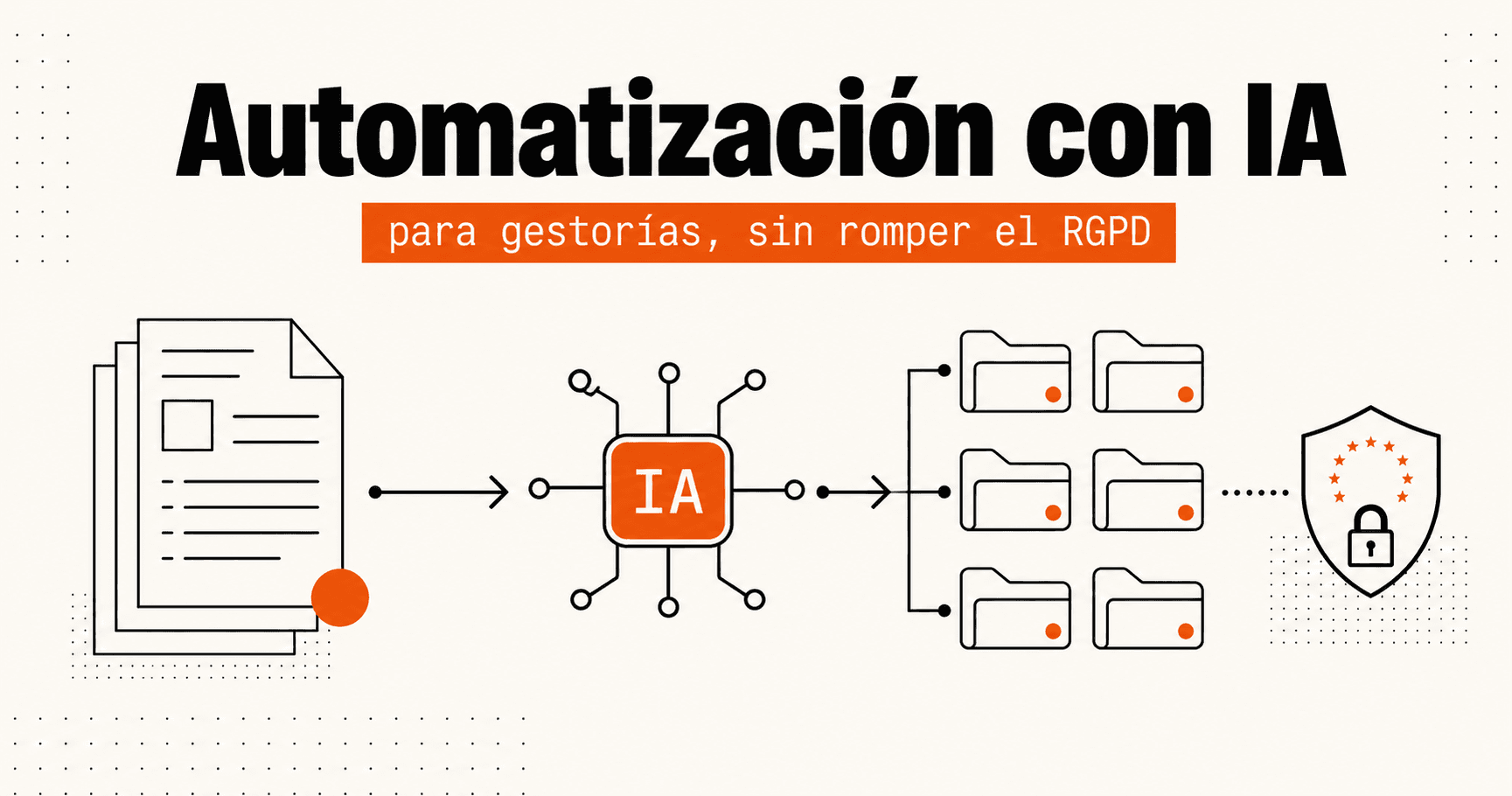
- Document intake and classification. Invoices, payroll, contracts arriving in every format through every channel. AI with OCR can read, classify, and file them, associating each document with the right client and expediente.
- Bank reconciliation and data entry. Matching movements and registering entries, the mechanical core of bookkeeping.
- First-level client queries. The repetitive questions ("what documents do you need from me", "is my declaration done yet") that interrupt the team all day, handled first by an assistant that escalates the genuinely complex ones to a human.
- Reminders and status chases. The renta-campaign ritual of manually emailing each client for missing documents, replaced by a flow that requests, reminds, and flags the file as complete.
Independent write-ups on Spanish firms put the typical saving at roughly 20 to 40 hours a month for a practice of four to ten people, depending on how many processes are covered. That is the equivalent of recovering close to half a full-time person from mechanical work, either as freed billable hours or as capacity to absorb the quarterly-close and renta peaks without hiring.
What does not automate well is professional criterion. Interpreting a genuinely ambiguous tax question, advising on a specific situation, deciding how to handle an edge case. The honest framing, and the one worth insisting on with any vendor, is that AI removes the data-keying so the asesor can do the analysis, not that AI replaces the asesor.
Need something more advanced?
Professional Package from €1,490. E-commerce, CMS, advanced SEO.
See Professional PackageThe non-negotiable: RGPD and the EU AI Act
This is the part the flashy demos skip, and for a firm handling clients' tax and personal data it is not optional. Client fiscal data is sensitive, and where and how it is processed is governed by the RGPD, now alongside the EU AI Act.
The constraints you have to hold any automation to:
- Know where the data is processed. Processing should stay within the EU, not be quietly shipped to a server or model outside it. Ask, and get the answer in writing.
- Sign the encargado de tratamiento contract. Any provider processing personal data on your behalf is a data processor and needs a proper contrato de encargado de tratamiento. No contract, no go.
- Data minimisation and access control. The automation should only touch the data it needs, and access should be logged and limited.
- Human oversight on anything that matters. An AI classifying a document is fine. An AI silently making a decision that affects a client's tax position is not, both under professional duty and the AI Act's expectations.
A useful rule of thumb: if a provider cannot tell you clearly where your clients' data lives and will not sign an encargado de tratamiento, the tool is not ready for a professional firm, however good the demo looks.
A word on generative AI and tax criterion
There is one specific trap worth naming. Using generative AI to draft an email or summarise a document is low-risk. Using it to interpret tax law and generate criterion is high-risk, because these models can produce confident, fluent answers that are simply wrong. A fabricated interpretation of the normativa, delivered to a client as if it were verified, is a professional liability, not a productivity gain. Keep generative AI on the mechanical and drafting tasks, and keep a human on the criterion.
Where SolidaWeb fits
Most of the automation sold to gestorías is generic SaaS: you rent it, your data lives on their platform, and you are locked into a subscription. That is fine for some firms, but it is not the only option, and it is not always the one that respects data sovereignty best.
What I build is the custom alternative: automation and document-intake tools designed around your actual workflow, integrated with the software you already use rather than replacing it, with the code owned by you and the data processing set up to meet the RGPD from the start. It pairs naturally with a secure client portal, which is often where the document flow into these automations begins.
The honest takeaway
AI automation in a gestoría is real and the time savings are real, but the value is in removing mechanical work, not in replacing professional judgement, and it only counts as a gain if it respects the RGPD. Automate the intake, the reconciliation, the reminders, the repetitive queries. Keep the criterion human. And never adopt a tool that cannot tell you where your clients' data is processed or will not sign the contract that the law requires. Done that way, the freed hours go straight back into the advice your clients actually value.
Need something more advanced?
Professional Package from €1,490. E-commerce, CMS, advanced SEO.
See Professional PackageSources
- AEPD, Agencia Española de Protección de Datos, guidance on data processors and processing of personal data under the RGPD (aepd.es), checked August 2026 [T1]
- Reglamento (UE) 2016/679 (RGPD) and Reglamento (UE) 2024/1689 (EU AI Act), on processing of personal data and AI system obligations, checked August 2026 [T1]