If you run a business or work as a self-employed professional in Spain, you have probably received at least one alarming email this year telling you that electronic invoicing is now mandatory and you must act immediately. The reality is more nuanced, and the nuance matters, because acting on the wrong date can mean paying for software you do not yet need, or ignoring a deadline that is closer than you think.
Here is the accurate picture, based on the official text published in the BOE, separating what is already law from what is still pending.
What actually happened: RD 238/2026
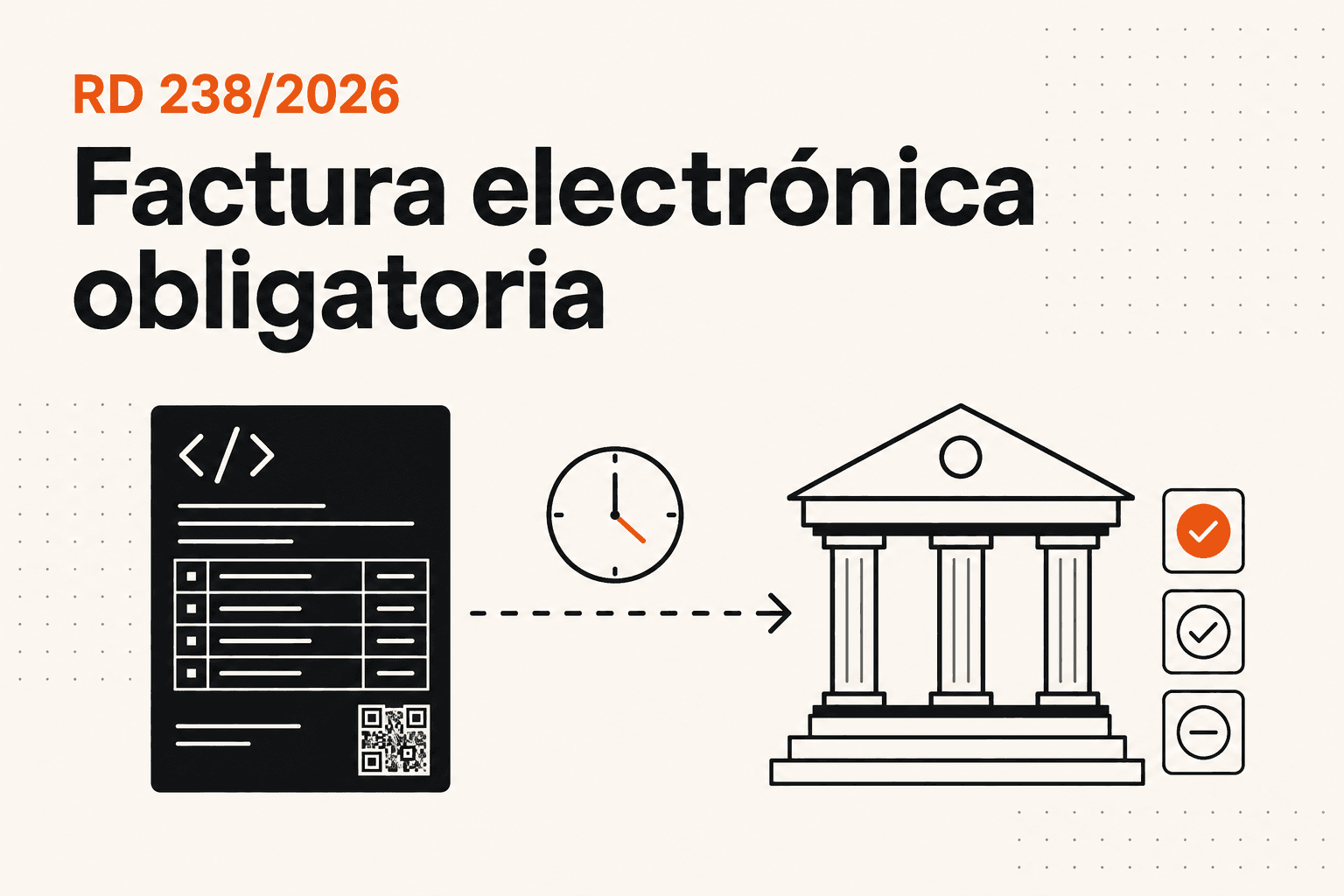
On 31 March 2026, the BOE published Real Decreto 238/2026, de 25 de marzo, the regulation that finally develops the mandatory business-to-business electronic invoicing system foreseen in the Ley 18/2022 (Crea y Crece). That law was approved back in 2022, but it left its practical application to a regulation that took more than three years to arrive. The RD is that missing piece.
The regulation entered into force twenty days after publication. But (and this is the part the alarmist emails skip) its effective application is deferred. The obligations do not start counting from the RD itself. They start counting from the entry into force of a separate Ministerial Order that will regulate the public invoicing solution the AEAT has to build. As of August 2026, that Order has not been published in its final form.
The two phases and how the clock works
Once the Ministerial Order enters into force, the obligation applies in two phases, based on each business's annual turnover:
- Twelve months after the trigger date: for businesses and professionals whose volume of operations exceeded 8 million euros in the previous calendar year.
- Twenty-four months after the trigger date: for everyone else, including the vast majority of pymes and autónomos.
Based on the current draft of the Ministerial Order, which points to an entry into force around late 2026, the practical calendar most sources project is roughly October 2027 for large companies and October 2028 for everyone else. But those dates are projections tied to a draft. The definitive calendar will only be fixed when the final Order is published in the BOE, and as recently as mid-August 2026 that Order was reported to still be held up.
The honest takeaway: the clock has not started yet, but the regulation is real and the two-year window will pass faster than it looks once it does.
Need something more advanced?
Professional Package from €1,490. E-commerce, CMS, advanced SEO.
See Professional PackageVerifactu is NOT the same thing (and both apply)
This is the single most common confusion, and it is worth being precise because they are two separate obligations with two separate calendars, and your business will likely have to comply with both.
Verifactu (from the Ley Antifraude, RD 1007/2023) regulates the software you use to generate invoices. It requires that software to be tamper-proof and traceable, sending or being able to send invoice records to the AEAT. Its deadlines are 1 January 2027 for companies paying Corporate Tax and 1 July 2027 for autónomos. Verifactu looks at your computer.
B2B e-invoicing (from Crea y Crece, RD 238/2026) regulates the format and exchange of the invoice between businesses. It requires invoices to be structured electronic documents in an admitted syntax, exchanged between companies, with a new obligation to report the invoice status. B2B e-invoicing looks at the envelope you send to your client.
A simple way to hold the two apart: Verifactu governs how you create the invoice, Crea y Crece governs how you send it and how the other party responds.
The genuinely new obligation: reporting invoice status
Beyond the format change, RD 238/2026 introduces something operationally significant that catches many businesses off guard: the obligation for the recipient to communicate the status of each invoice (acceptance, rejection, and effective payment) within a maximum of four calendar days.
This is not just a technical detail. It changes cash-flow and administrative workflows, because someone in the business has to manage those status communications, or the software has to automate them. For a gestoría advising multiple clients, this is a process that needs designing well before the deadline arrives.
What you can (and should) do now
There is no need to panic-buy anything today, but there is a sensible set of preparations that cost nothing and save pain later:
- Get your Verifactu date on the calendar first. It arrives before B2B e-invoicing (January and July 2027), so for most businesses it is the more urgent of the two.
- Ask your invoicing software provider whether their roadmap covers both Verifactu and the Crea y Crece structured formats (Facturae, UBL, CII). If you invoice with Excel, Word, or an in-house system, you will need to change systems, not just tweak a process.
- Clean your customer and supplier data. Structured invoicing is unforgiving with messy tax IDs and inconsistent records.
- Map who will handle invoice-status reporting and whether your software can automate the four-day communication.
Need something more advanced?
Professional Package from €1,490. E-commerce, CMS, advanced SEO.
See Professional PackageWhere SolidaWeb fits
I am not an invoicing-software vendor, and this article is not trying to sell you one. But if your business needs custom tools around invoicing (a client portal that centralises documents, an integration between your systems, or automation of the status-reporting workflow), that is exactly the kind of operational software I build, with the code owned by you and no eternal subscription attached.
If you run a gestoría or asesoría and want your document and invoice workflows in order before these deadlines land, the client-portal approach I describe here is a good place to start.
Sources
- BOE, Real Decreto 238/2026, de 25 de marzo (BOE-A-2026-7295), checked August 2026 [T1]
- BOE, Ley 18/2022, de 28 de septiembre, de creación y crecimiento de empresas (Crea y Crece), checked August 2026 [T1]
- BOE, Real Decreto 1007/2023 (Verifactu / Reglamento sistemas informáticos de facturación), checked August 2026 [T1]